
Petriflow 102 - Part 2
Interpretation of Places and Model Semantics
💡 What you'll learn
Learn how places in Petri nets can represent not only abstract states but also physical or logical entities, and how changing their interpretation affects workflow meaning.
Overview
Goal & Context
In the second part of the lecture, we expand the concept of places introduced in Part 1. While places previously represented abstract workflow states (Request submitted, Registered, etc.), they can also represent physical objects or resources.
To illustrate this, the speaker uses the bicycle assembly example - a metaphor for understanding how tokens and places interact when representing real-world entities.
This section also introduces the concept of interpretation, explaining that Petri nets themselves are neutral mathematical structures - it’s the modeler who assigns meaning.
Key concepts
Interpretation of Places
Originally, Carl Adam Petri used Petri nets to model chemical reactions. Each place corresponded to a molecule, and transitions described reactions that produced or consumed them.
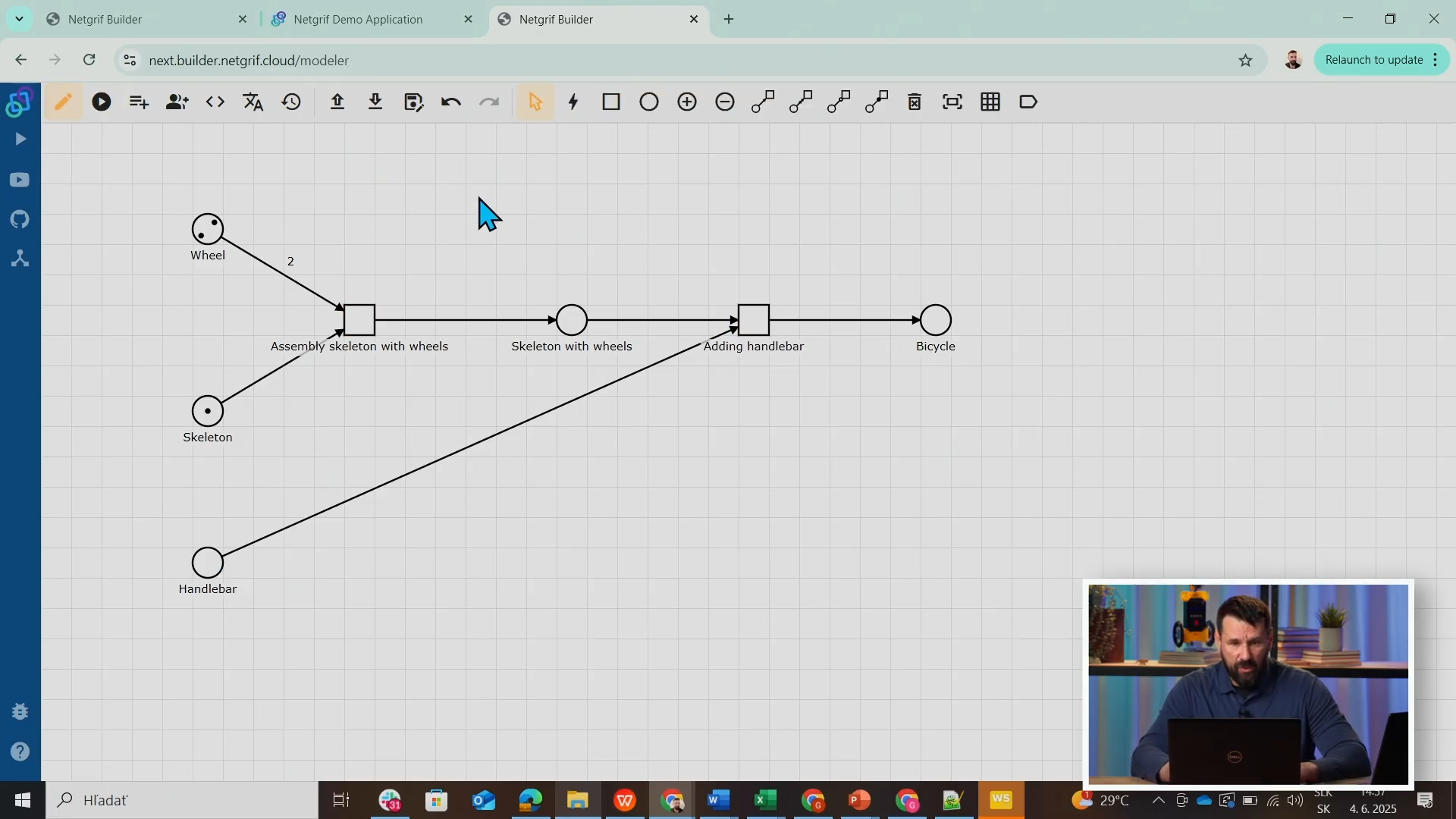
In the workflow analogy, the same principle applies - but now, places can represent objects like wheels, skeletons, or handlebars.
| Place | Represents | Token Meaning |
|---|---|---|
| Wheel | Type of part | Each token = one wheel |
| Skeleton | Base of bicycle | Each token = one frame |
| Handlebar | Component | Each token = one handlebar |
| Bicycle | Finished product | Token = completed bicycle |
NOTE
The multiplicity of tokens has physical meaning (e.g., two tokens = two wheels). This makes the model closer to object-oriented logic, where tokens correspond to instances of objects rather than abstract states.
Assembling the Bicycle
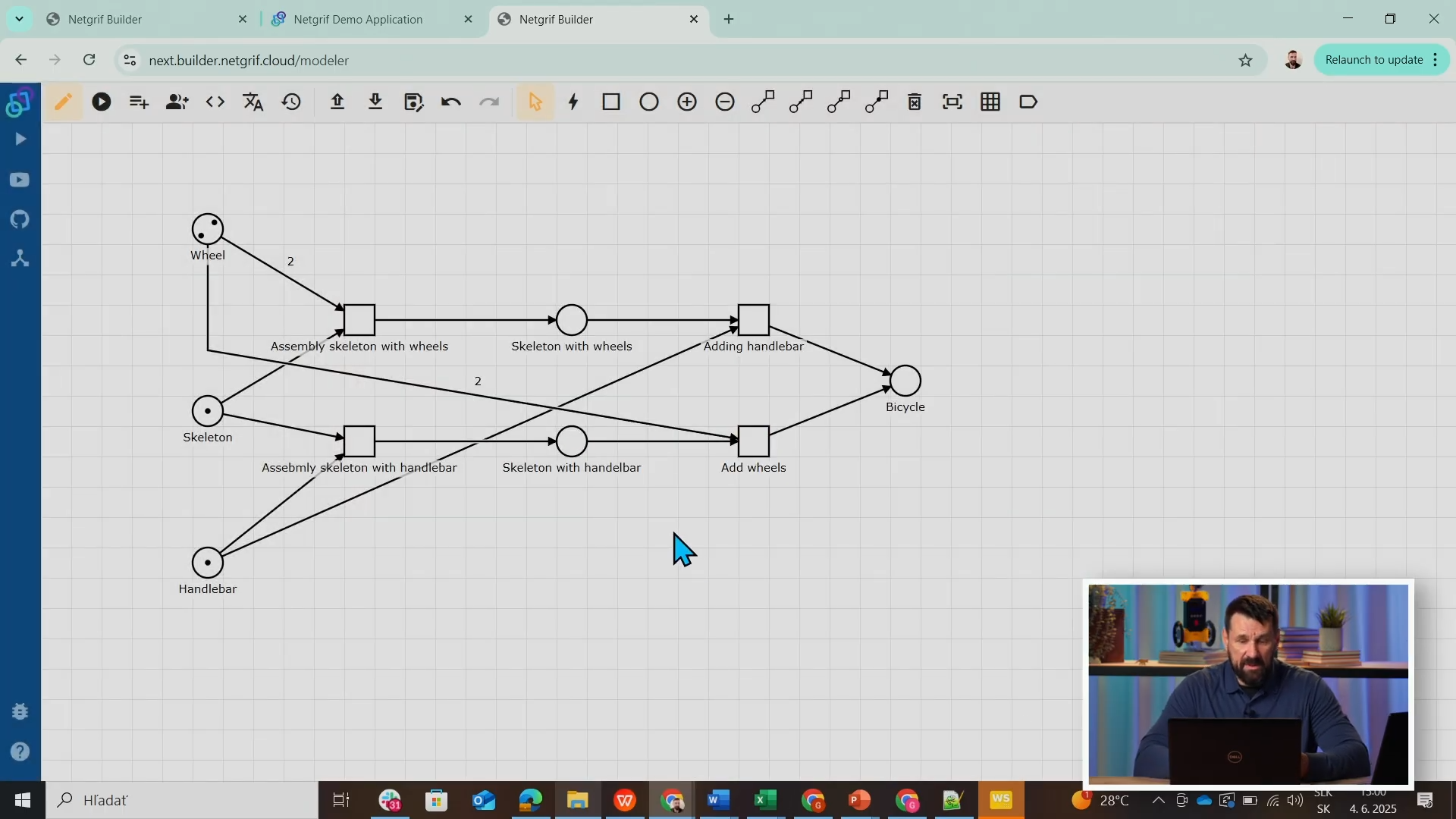
The Petri net demonstrates multiple ways to assemble a bicycle using these elements:
- Add wheels → Add skeleton → Add handlebar
- Or Combine skeleton + handlebar first → then add wheels
These alternative execution paths show concurrency and flexibility within Petri nets - the same end result (a bicycle) can be achieved through different sequences of transitions.
NOTE
The Petri net becomes an information system describing how assembly steps are ordered and related.
From Instance to System Model
Initially, the model describes one bicycle - a single instance. However, by changing the interpretation, we can model an entire garage or workshop assembling many bicycles simultaneously.
| Interpretation | Meaning |
|---|---|
| Instance level | A single bicycle being assembled |
| System level | A workshop managing wheels, skeletons, handlebars, and bicycles |
This shows that Petri nets have no inherent semantics - the interpretation defines what the system models.
For example:
- A token may represent one wheel or one request
- A place may represent availability of a part or a workflow state
NOTE
The same structure can model completely different realities depending on interpretation.
Marking and State Meaning
The marking (number of tokens in each place) represents the state of the system.
In the garage example, the marking can show:
- 2 wheels available
- 0 skeletons left
- 2 handlebars in stock
- 3 skeletons with wheels
- 1 skeleton with handlebar
- 0 bicycles ready to sell
By executing transitions (e.g., Add handlebar to skeleton with wheels), the system evolves to a new state - two ready bicycles appear in the output place.
NOTE
The marking + active tasks together define the workflow state in Petriflow.
Video
Watch the lecture segment from Petriflow 102 - Part 2 (13:42 – 25:40).
Visual steps
1️⃣ Bicycle Assembly Example
Places represent parts (wheel, skeleton, handlebar), transitions represent assembly steps.
2️⃣ Alternative Sequences
Multiple paths to achieve the same result - illustrating concurrency and flexibility. Model scales to system level, representing stock and production states of multiple bicycles.
Summary
| Concept | Description |
|---|---|
| Interpretation | Meaning assigned by the modeler - defines what tokens and places represent |
| Instance vs System | Model can represent one object (bicycle) or an entire system (garage) |
| Multiplicity of Tokens | Represents real quantities (e.g., two wheels) |
| Marking | Number of tokens = current state of the system |
| Neutral Semantics | Petri nets themselves have no built-in meaning |
Takeaway:
Petri nets are a neutral mathematical framework. By interpreting their elements, you transform them into domain-specific workflow models.
Petriflow builds on this flexibility - connecting theory, object semantics, and process execution.
You now understand:
- How Petri nets can model physical or abstract entities
- The role of interpretation in giving meaning to places and tokens
- How markings define workflow or system state
- How Petriflow leverages these semantics to describe real processes